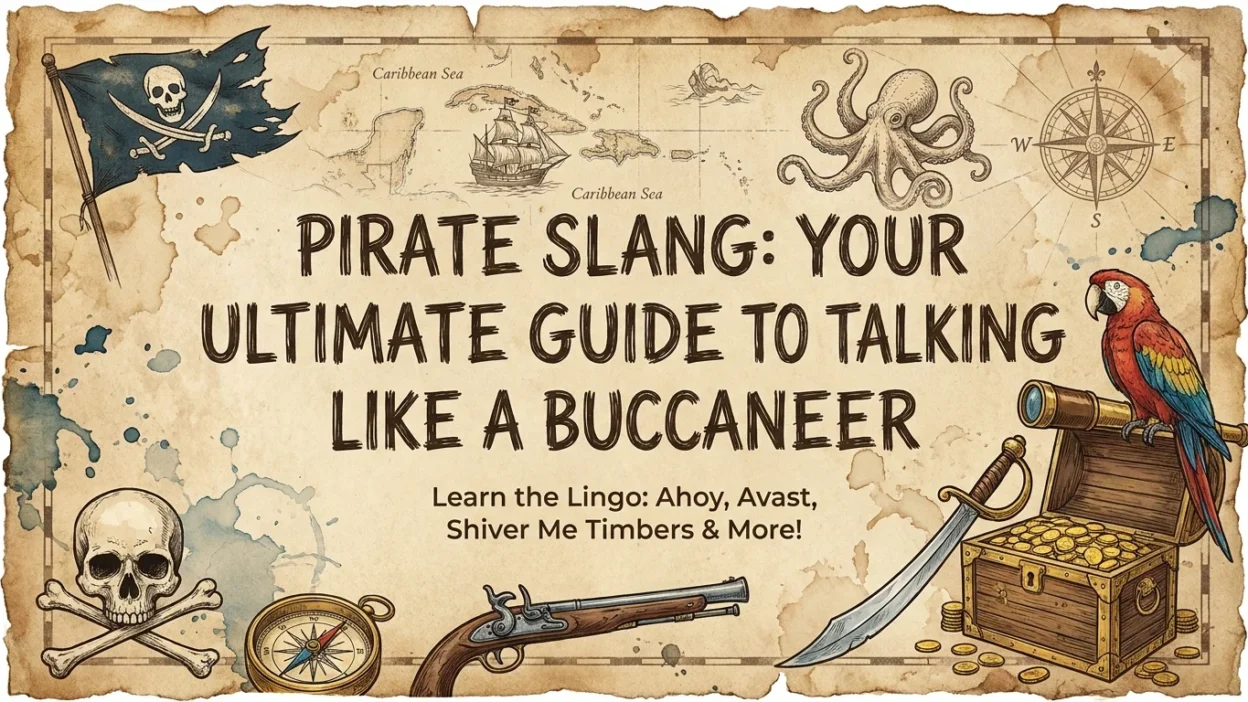
Avast ye, matey! Have you ever wanted to talk like a swashbuckling pirate? Maybe you’ve heard phrases like “shiver me timbers” and wondered where they came from. Or perhaps you’re preparing for International Talk Like a Pirate Day and need to brush up on your pirate lingo.
Pirate slang is one of the most recognizable dialects in popular culture. It’s fun, it’s colorful, and it’s got a fascinating history. The way we think pirates talked is mostly fiction. But that doesn’t make it any less entertaining.
This guide will teach you everything you need to know about pirate slang. We’ll cover greetings, insults, treasure terms, and more. We’ll even explain the real origins behind some of these phrases.
So, hoist the Jolly Roger and let’s set sail on this linguistic adventure!
H2: Essential Pirate Greetings and Exclamations
These are the words you’ll use most often. They’re the foundation of pirate speech.
Ahoy
“Ahoy” is the classic pirate greeting. It’s like saying “Hello!” or “Hey there!” Pirates use it to get someone’s attention or greet a fellow sailor. It’s simple, effective, and instantly recognizable. You’ll hear it in almost every pirate movie and book.
Avast / Avast Ye
“Avast” means “stop” or “pay attention.” When a pirate yells “Avast ye!” they’re telling you to stop what you’re doing and listen up. Don’t confuse it with “ahoy” – they mean very different things! Saying “avast” when you mean “hello” will make you sound like a pirate wannabe.
Yo-Ho-Ho
This is a jolly expression of delight. It’s often used as a greeting or a cheer. The famous pirate song from Treasure Island goes: “Fifteen men on the dead man’s chest – Yo-ho-ho, and a bottle of rum!”
Arrr, Arrgh, Yarr, Gar
These are the iconic pirate growls. They don’t have a specific meaning. Pirates use them to emphasize a point, show emotion, or just sound menacing. The most famous is “Arrr!” Make sure to roll your “R” for maximum effect.
Blimey!
“Blimey!” is an expression of surprise or disbelief. It’s like saying “Wow!” or “I can’t believe it!” Pirates use it when they’re shocked.
Shiver Me Timbers
“Shiver me timbers” is a classic exclamation of surprise or shock. It refers to the timbers (wooden planks) of a ship shaking or splintering when hit by a cannonball. It’s one of the most famous pirate phrases, even though it’s purely fictional.
H2: Pirate Greetings and Addressing Others
Matey
“Matey” means friend or companion. It’s a term of address for fellow pirates. Think of it like saying “buddy” or “pal.” Calling someone “matey” shows camaraderie.
Hearties
“Hearties” is another word for friends or comrades. You might hear a pirate captain say “Avast, me hearties!” to address the crew. It means “Hey, my friends!”
Me
Pirates use “me” instead of “my.” For example, “That’s me ship” means “That’s my ship.” This adds to the distinctive pirate dialect.
Ye
“Ye” is the pirate version of “you.” “How are ye feeling today?” means “How are you feeling today?” It’s a small change but it makes a big difference in sounding authentic.
Lad / Lass
“Lad” refers to a boy or young man. “Lass” refers to a girl or young woman. “Lassie” is a variant. Pirates use these terms when referring to younger people.
Bucko
“Bucko” is another word for a friend or companion. It’s similar to “matey.” You might hear it in casual pirate conversation.
Wench
“Wench” is a word for a woman. It’s often used in a disrespectful or objectifying way. You’ll hear it in pirate fiction, but be careful using it today.
H2: Pirate Insults and Put-Downs
Scallywag
“Scallywag” is a term for a rascal or a mischievous person. Experienced pirates might call a newbie or a troublemaker a scallywag. It’s a playful insult that’s not too harsh.
Landlubber
“Landlubber” is one of the classic pirate insults. It means someone who’s not used to life at sea. Experienced sailors use it to mock clumsy or inexperienced people. It’s a way of saying “you’re useless on a ship.”
Scurvy
“Scurvy” is a disease caused by vitamin C deficiency. Pirates use it as an insult meaning “lowly” or “disgusting.” “Ye scurvy dog!” means “You worthless person!” It’s a colorful way to put someone down.
Bilge Rat
A “bilge rat” is an insulting term for a contemptible person. The bilge is the lowest part of a ship, where dirty water collects. Calling someone a bilge rat means they’re as low and dirty as a rat in the ship’s filth.
Lily-Livered
“Lily-livered” means cowardly or timid. The liver was thought to be the seat of courage. A lily-livered person has a pale, cowardly liver. It’s a poetic way to call someone a coward.
Son of a Biscuit Eater
This is a creative pirate insult. It’s a way of calling someone weak or unmanly. It’s less vulgar than modern insults but gets the point across.
I’ll Crush Ye Barnacles
This is a common pirate threat. It means “I’ll beat you up” or “I’ll destroy you.” It’s a colorful way to threaten someone.
H2: Pirate Treasure and Wealth Terms
Booty
“Booty” refers to treasure and valuables stolen from other ships. It’s the main goal of any pirate raid. When pirates capture a ship, they’re after the booty.
Loot
“Loot” is another word for stolen money or possessions. It’s very similar to booty. Pirates use both terms interchangeably.
Plunder
“Plunder” can be a verb or a noun. As a verb, it means to steal and rob. As a noun, it refers to the stolen goods themselves. Pirates plunder for plunder.
Doubloon
A “doubloon” is a Spanish gold coin. Pirates use it as a general term for money. It’s a classic piece of pirate treasure. Even though it specifically refers to a Spanish coin, pirates use it for any valuable money.
Pieces of Eight
“Pieces of eight” were Spanish silver coins. They were common currency during the Golden Age of Piracy. Pirates loved them. “Pieces of eight” has become a classic pirate treasure phrase.
Prize
A “prize” is a ship captured by pirates. When pirates take over another vessel, they call it a prize. It’s their reward for a successful attack.
Bounty
“Bounty” refers to a reward for capturing a pirate or criminal. It’s what governments offer to catch pirates. Pirates fear bounties because they attract bounty hunters.
H2: Pirate Actions and Activities
Pillage
To “pillage” means to rob and steal from a captured ship or town. It’s one of the main activities of pirates. When pirates pillage, they take everything of value.
Walk the Plank
“Walk the plank” is a classic pirate punishment. A blindfolded prisoner is forced to walk off a wooden plank extending over the side of the ship. They fall into the water and drown. Historians debate how common this was. It’s more of a fictional invention than a real practice. But it’s one of the most famous pirate phrases.
Maroon
To “maroon” someone means to abandon them on a desert island with no food, water, or supplies. Pirates used this punishment for troublemakers, deserters, and thieves. It was often a slow death from thirst or starvation. Some pirates even gave their victims a pistol so they could shoot themselves.
Keelhaul
“Keelhaul” is a severe punishment. It involves tying a person with rope, throwing them overboard, and dragging them under the ship from one side to the other. The person is scraped against the barnacles on the ship’s bottom. It’s a brutal and often fatal punishment. The word comes from the Dutch “kielhalen.”
Hornswoggle
To “hornswoggle” means to cheat, trick, or deceive someone. It’s a way of saying “I fooled you.” Pirates use it when they’ve swindled someone out of their money or goods.
Weigh Anchor
“Weigh anchor” means to pull the anchor up and get ready to sail. It’s a command to get moving. When a pirate captain says “weigh anchor,” it’s time to go!
Cast Off
“Cast off” means to release the ropes tying the ship to the dock. It’s the command to set sail. Once the lines are cast off, the ship is free to leave port.
Heave To
“Heave to” means to bring the ship to a stop. It involves adjusting the sails and rudder to maintain position. Pirates heave to when they want to stop and wait for something.
Batten Down the Hatches
“Batten down the hatches” means to prepare for a storm. It involves covering the hatches (openings on the deck) to keep water out. Pirates use it as a command to secure the ship and get ready for trouble.
H2: Pirate Phrases and Expressions
Dead Men Tell No Tales
“Dead men tell no tales” is a famous pirate saying. It means dead people can’t reveal secrets. It’s both a threat and a reason pirates didn’t spare many survivors. If you kill everyone, there are no witnesses.
Give No Quarter
“Give no quarter” means to show no mercy. It’s a command to take no prisoners and show no mercy to the enemy. When pirates say “give no quarter,” they’re saying everyone will die. It’s the opposite of showing mercy.
Davy Jones’ Locker
“Davy Jones’ locker” is a phrase meaning the bottom of the sea. It’s where dead sailors and pirates go when they drown. According to sailor’s lore, Davy Jones is an evil sea spirit. His locker is the graveyard at the bottom of the ocean.
Three Sheets to the Wind
“Three sheets to the wind” means someone is very drunk. It comes from sailing terms. A “sheet” is a rope that controls a sail. If three sheets are loose, the ship is out of control. So a person who’s “three sheets to the wind” is equally out of control from drinking. One sheet means mildly drunk, and four sheets means passed out.
Chock-a-Block
“Chock-a-block” means something is completely full. It comes from sailing. When blocks (pulleys) are chock-a-block, the tackle is fully extended and can’t move further. Pirates use it to describe a ship that’s packed with people or treasure.
Give a Wide Berth
“Give a wide berth” means to avoid something. It comes from anchoring far away from another ship to avoid collision. Pirates use it to say “stay away from that person or place.” If you give someone a wide berth, you avoid them deliberately.
Talk Bilge
“Talk bilge” means to speak nonsense. The bilge is the lowest part of the ship where dirty water collects. If someone is talking bilge, they’re talking rubbish. It’s a way of saying “you don’t know what you’re talking about.”
Run a Rig
“Run a rig” means to play a joke or trick on someone. It’s a lighter, more playful way of saying you fooled someone. It’s related to “hornswoggle” but less serious.
No Purchase, No Pay
“No purchase, no pay” was a real pirate rule. It meant a pirate would receive no reward unless booty was taken. “Purchase” is an old word for plunder. It survives today in marine salvage where “no cure, no pay” means crews only get paid if they successfully salvage a vessel.
Going on the Account
“Going on the account” was a pirate term for turning to piracy. It meant a sailor had left legitimate work to become a pirate. It was first used in the 16th century. The expression meant that no wages would be paid until booty had been taken.
Dance the Hempen Jig
“Dance the hempen jig” is a pirate euphemism for hanging. The “hempen jig” refers to the hemp rope used for a noose. To dance it is to be executed by hanging. It’s a grim but colorful way to talk about execution.
Land Ho!
“Land ho!” is the cry uttered by a lookout when they first see land. It’s the signal that the journey is almost over. It’s one of the most exciting cries on a pirate ship.
Sink Me!
“Sink me!” is an exclamation of surprise or shock. It’s like saying “Well, I’ll be damned!” It’s a light oath that pirates use when they’re amazed.
Clap of Thunder
“Clap of thunder” refers to a strong alcoholic drink, usually a shot. It’s a pirate term for hard liquor. If you order a “clap of thunder,” you’re getting something strong.
Fire in the Hole
“Fire in the hole” is a warning that a cannon is about to be fired. Pirates use it to alert the crew before a cannon shot. It warns everyone to stand clear.
Fair Winds
“Fair winds” is a way of wishing someone good luck. It means favorable winds for sailing. Pirates use it as a blessing. You might say “fair winds and following seas” to a departing friend.
Crack On
“Crack on” means to make good speed on the ship. It comes from the cracking sound made by sails and ropes when the ship is moving fast. Pirates say “crack on” when they want to go faster.
Cut Loose
To “cut loose” means to make a quick departure or escape. It comes from cutting the anchor cable rather than pulling it on board. If a pirate needs to escape quickly, they cut loose.
H2: Pirate People and Roles
Buccaneer
A “buccaneer” is another word for a pirate. It specifically refers to pirates who operated in the Caribbean Sea. The term originates from the French word “boucan,” which was a wooden frame used to smoke meat. Caribbean pirates used these frames to cook, and the name stuck.
Privateer
A “privateer” is a pirate with a license. They were commissioned by a government to attack enemy ships. They operated under a “Letter of Marque.” It’s piracy that’s legal because the government authorized it. Sir Francis Drake and Sir Henry Morgan were actually privateers, not pirates.
Corsair
A “corsair” is a pirate who operated off the Barbary Coast of North Africa. The term is often used for Mediterranean pirates. They were famous for capturing ships and enslaving crews.
Swashbuckler
A “swashbuckler” is a daring, adventurous pirate. It originally meant someone who made a lot of noise with their sword. A “swash” was a blow, and a “buckler” was a shield. Swashbucklers were flashy, confident, and skilled in combat.
Sea Dog
A “sea dog” is an experienced sailor or pirate. It’s a term of respect for someone who’s been at sea for many years. An “old salt” is similar. These are the veterans who know everything about life on the ocean.
Old Salt
An “old salt” is another term for an experienced sailor. It’s a veteran of the sea. Pirates respect old salts for their knowledge and experience.
Mate
A “mate” is a fellow crew member. It’s been in use since the 14th century. It’s also the title of an officer on merchant and naval ships. The mate is in charge of cargo, daily tasks, and making sure the captain’s orders are followed.
Matelot
A “matelot” was a very close relationship between two men. They lived together, ate together, shared their possessions, and looked after each other in battle and illness. It was more involved than just being “mates.” It was particularly common in pirate havens.
Grommet
A “grommet” was pirate slang for a ship’s boy or apprentice. It comes from the Spanish word “grumete.” Young boys served as apprentices on ships. They learned the trade and eventually became full crew members.
Marooner
“Marooner” was applied to Caribbean pirates in the 17th century. It comes from the Spanish word “cimarrónes,” which referred to escaped slaves. The term was then applied to pirates operating in the same region.
Cap’n
“Cap’n” is the shortened form of captain. It’s a term of respect. Even in the modern corporate world, bosses secretly love being called “Cap’n.” It’s a fun way to acknowledge leadership.
H2: Pirate Ships and Nautical Terms
Jolly Roger
The “Jolly Roger” is the famous pirate flag. It’s usually black with a white skull and crossbones. It was flown by pirate ships to identify themselves before battle. It struck fear into the hearts of their victims. The Jolly Roger is the most recognized symbol of pirates.
Cutlass
A “cutlass” is the classic pirate sword. It has a single, slightly curved edge and a basket-shaped guard to protect the hand. It was practical for close combat on ships. Pirates favored the cutlass because it was sturdy and reliable.
Crow’s Nest
The “crow’s nest” is a small platform high on the mast. Lookouts stand there to spot land or enemy ships. It gives them the best view of the horizon. It’s a vital part of any pirate ship.
Galley
The “galley” is the kitchen on a ship. It’s where the cook prepares meals. The term is still used in modern navies. It’s one of the most important places on the ship.
Keel
The “keel” is the bottom-most part of the ship. It’s the main structural beam running along the bottom. A ship “keels over” when it capsizes and rolls onto its side.
Mainmast
The “mainmast” is the tallest mast on the ship. It’s central to the ship’s structure. It’s often where the Jolly Roger flies.
Gunwale
The “gunwale” is the upper edge of the ship’s side. It’s where the guns are mounted. It’s a key part of the ship’s structure.
Forecastle
The “forecastle” is the forward part of the upper deck. It’s where the crew quarters are often located. It’s one of the most important areas of the ship.
Brigantine / Sloop / Galleon
These are different types of pirate ships:
- A brigantine is a two-masted ship.
- A sloop is a smaller, faster ship.
- A galleon is a large, heavily armed ship used by the Spanish.
Galley (Type of Ship)
A galley was a large medieval vessel with a single deck. It was propelled by both sails and oars. It had guns at the stern and prow. A galley could carry up to 1,000 men. It was used mainly in the Mediterranean.
H2: Real Pirate History vs. Fiction
It’s important to understand that the pirate slang we love today is mostly fictional. Real pirates didn’t talk like pirates in movies.
What Real Pirates Sounded Like
Real 17th-century pirates spoke the same way as ordinary sailors of their time. They didn’t have a special dialect. They used Early Modern English, the same as everyone else. The distinctive pirate accent and vocabulary came from fiction.
The Influence of Treasure Island
Robert Louis Stevenson’s 1883 novel Treasure Island created the modern image of pirates. Much of what we know about pirates comes from this single book.
The Birth of International Talk Like a Pirate Day
International Talk Like a Pirate Day is celebrated on September 19 every year. It was created in 1995 by two friends in Oregon. It’s a fun holiday where people dress up and talk like pirates. It has helped keep pirate slang alive and popular.
Hollywood’s Contribution
Hollywood films cemented the pirate image. Movies like The Pirates of the Caribbean popularized phrases like “savvy?” and “battle stations.” They gave us the swashbuckling, charming pirate we know today. Johnny Depp’s performance as Jack Sparrow created a new generation of pirate fans.
H2: Sexual Slang Related to “Pirate”
The word “pirate” also appears in sexual slang. These meanings are completely different from pirate lingo.
On the Pirate (Australian Slang)
In Australian slang, “on the pirate” means a man is searching around for casual sex. The verb “to pirate” is also used. It plays off the idea that pirates take what they want. This is the most common sexual use of the term.
The Angry Pirate (Fictional Act)
“The Angry Pirate” is a fictional sex act. It was described to sex columnist Dan Savage by a reader. The story goes that a man ejaculates in a woman’s eye and then kicks her shin. It’s a joke. Savage confirmed that it’s fiction, like a “donkey punch” or “Hot Karl.” It’s not a real practice.
Butt Pirate / Ass Pirate
“Butt pirate” and “ass pirate” are derogatory slurs for gay men. They are offensive terms. You should avoid using them.
Pamper Pirate
“Pamper pirate” is a derogatory term for a child molester. It’s a very offensive term that you should never use.
Tango Pirate
“Tango pirate” was popularized in the early 20th century. It described gigolos who sought out wealthy women at dances. It plays off the idea of the pirate as a seducer.
H2: FAQs About Pirate Slang
What is the most famous pirate slang?
“Shiver me timbers” is probably the most famous pirate phrase. It’s an exclamation of surprise. “Ahoy” and “Avast” are also extremely well-known. “Arrr!” is the iconic pirate sound.
What does “avast” mean in pirate slang?
“Avast” means “stop” or “pay attention.” It’s a command to halt what you’re doing. Pirates use it when they have something important to say. Don’t confuse it with “ahoy” (hello).
What does “booty” mean in pirate slang?
“Booty” means treasure and valuables stolen from other ships. It’s the main goal of piracy. Pirates are always after the booty.
What does “landlubber” mean?
“Landlubber” is an insult for someone who’s not used to life at sea. It means the person is clumsy, stupid, or inexperienced on a ship. Sailors use it to mock people who don’t know nautical tasks.
Did pirates really talk like they do in movies?
No. Real pirates spoke the same way as other sailors of their time. The distinctive pirate lingo comes from fiction. Treasure Island and Hollywood movies created the dialect we know today.
What is International Talk Like a Pirate Day?
It’s a fun holiday celebrated on September 19 every year. People dress up and talk like pirates. It was started in 1995 by two friends in Oregon. It’s a chance to have fun with pirate slang.
What does “Davy Jones’ Locker” mean?
“Davy Jones’ Locker” is the bottom of the sea. It’s where drowned sailors end up. Davy Jones is an evil sea spirit. His locker is the graveyard at the ocean’s depths.
Conclusion: Mastering the Art of Pirate Slang
Pirate slang is a fascinating mix of real nautical terms and fictional inventions. It’s fun, colorful, and instantly recognizable. From “shiver me timbers” to “yo-ho-ho,” these phrases have become a permanent part of popular culture.
We’ve covered everything in this guide. You now know how to greet someone like a pirate (“Ahoy, matey!”), insult them (“Ye scurvy landlubber!”), and talk about treasure (“That’s a fine booty!”). You also know the real history behind these terms.
So next time you see an opportunity, don’t be afraid to talk like a pirate. Whether it’s for International Talk Like a Pirate Day, a costume party, or just for fun, you’ll now have the vocabulary to sound authentic. Just remember, the real pirates of history didn’t talk this way. But that’s what makes it so much fun!

Kenneth Green is a writer at Namevity who shares creative ideas for game names, team names, and unique names. He focuses on helping readers find memorable and inspiring names for their profiles, teams, and projects.