
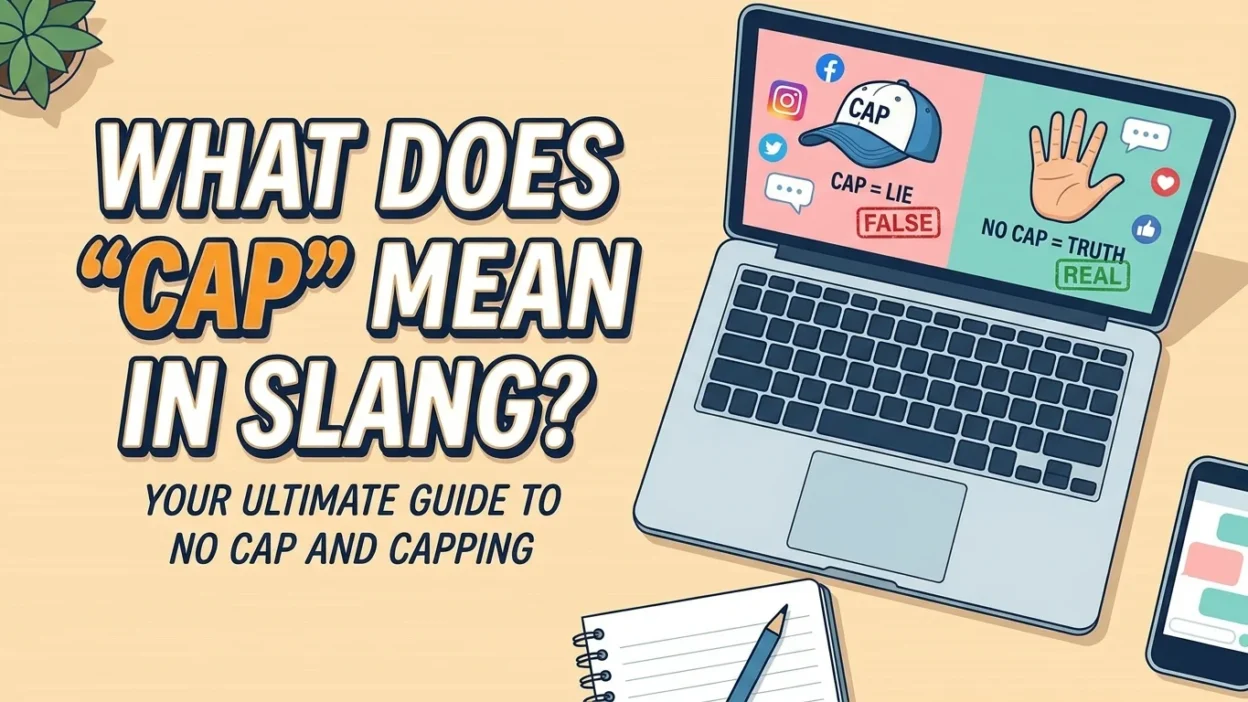
Have you seen people saying “no cap” on TikTok? Maybe your teen keeps saying “that’s cap” and you have no idea what they mean. Or perhaps you’ve heard rappers use “capping” in their lyrics. It’s everywhere these days. But what does it actually mean?
Welcome to the world of modern slang. “Cap” and “no cap” have become essential parts of Gen Z vocabulary. They’re used in texts, on social media, in memes, and in everyday conversation. Understanding them is key to keeping up with today’s language.
Don’t worry, though. We’ve got you covered. This guide will explain everything about “cap” slang. And we’ll share real examples so you can master it.So, let’s dive in. By the end, you’ll be using “cap” and “no cap” like a pro.
H2: What Does “Cap” Mean in Slang? The Basic Definition
Let’s start with the simple definition. What does “cap” mean in slang? It means a lie, an exaggeration, or something that’s not true.
“That’s Cap” – Calling Out a Lie
When someone says “that’s cap,” they’re calling out a statement as false or exaggerated. It’s a direct way to say “that’s a lie” or “you’re bullshitting”.
Examples:
- “You met Drake? That’s cap.” – You’re saying they’re lying.
- “He said he can run a 4-minute mile – major cap.” – You think it’s an exaggeration.
- “That’s cap, quit bullshitting.” – A blunt way to call someone out.
“No Cap” – Emphasizing the Truth
On the flip side, “no cap” means “no lie” or “for real.” It’s used to add emphasis and signal that what someone is saying is 100% true. Think of it like adding an exclamation point to a promise, a hot take, or a bold claim.
Examples:
- “This was the best pizza I’ve ever had – no cap.” – You really mean it.
- “No cap, I studied for five hours straight.” – You’re being completely honest.
- “Life is short. It’s ok to stop reading something you’re not digging. No cap.” – You’re giving genuine advice.
“Capping” – The Verb Form
You’ll also hear “capping” used as a verb. It means actively lying or exaggerating.
Examples:
- “These rappers be capping.” – They’re lying in their lyrics.
- “Are you capping right now or did that really happen?” – Asking if someone is lying.
H2: Where Did “Cap” and “No Cap” Come From? The Fascinating History
The history of “cap” is surprisingly rich. It goes back centuries, not just a few years.
The 1500s: Verbal Jousting
Believe it or not, the roots of “capping” go back to the 1500s. Back then, “to cap” meant to cap an anecdote, proverb, quotation, or verse as part of a verbal jousting game. The goal was to have the last word with the best or most appropriate response.
The 1800s: Telling Better Jokes
By the mid-1800s, “capping” became about telling a better joke or a better story than someone else. It was a form of competition in barrooms and pubs.
The 1940s: The Dozens and African American Vernacular English
The most direct connection to today’s “cap” comes from Black American communities in the 1940s. “Capping” became a formalized exchange of insults known as “the dozens” or “the dirty dozens”.
Think “Yo Mama” jokes – but much more elaborate and witty. These were often exaggerations on someone’s character or circumstances. In that way, “capping” became a synonym for stretching the truth or lying.
Linguist Kelly Elizabeth Wright explains: “Capping as a behavior was and is often used by African Americans while playing The Dozens, which is a social game involving insulting others with exquisite wordplay for fun”.
The 1980s-2010s: Hip-Hop and Mainstream Popularity
The term “high capping” (meaning exaggerating your status) appeared in rap songs in the late 1980s. Willie D.’s 1989 song “Put The Fuckin’ Gun Away” included the line: “before that high-cappin’ shit get you killed”.
But “no cap” as we know it today was popularized in the 2010s by Atlanta hip-hop artists. The Migos song “Deadz” (2017) and Future & Young Thug’s “No Cap” helped spread the phrase into the mainstream.
From there, “no cap” and “cap” exploded on social media platforms like TikTok, Twitter, and Instagram. They became core parts of Gen Z and internet vocabulary.
H2: How to Use “Cap” and “No Cap” in a Sentence (with Real Examples)
The best way to learn slang is to see it in action. Here are real examples showing how people use “cap” and “no cap” in different contexts.
- “You met Drake? That’s cap.” – Calling out an unbelievable claim.
- “He said he has a new sports car, but that’s cap.” – Doubting someone’s statement.
- “I know he’s capping right now. There’s no way he makes that much money.” – Accusing someone of lying.
- “Would you quit capping? I know you don’t make that much money.” – Directly calling someone out.
- “This is the best burger I’ve ever had, no cap.” – Emphasizing a genuine opinion.
- “No cap, I’m quitting my job today.” – Showing you’re serious about a big decision.
- “Orlando ain’t really all that, I think I like Tallahassee better, no cap.” – Giving an honest opinion.
- “No cap, I saw it with my own eyes.” – Insisting you witnessed something.
- Friend: “You can’t be serious right now.”
- You: “I really am, no cap.” – Confirming you’re serious.
People often use the 🧢 (billed cap) emoji to represent “cap” visually. For example:
- “That’s 🧢.” – That’s a lie.
- “No 🧢.” – No lie, for real.
H2: Other Meanings of “Cap” You Should Know
While the “lie” meaning is the most common in modern slang, “cap” has other meanings too. Context is everything.
1. To Kill Someone (Older Slang)
“To cap someone” has historically meant to kill someone, especially with a gun. This is an older usage, but you might still hear it in movies or older rap songs.
2. An Upper Limit (Literal Meaning)
This is the traditional dictionary definition. A “cap” is a limit or a maximum. This meaning is still used in financial and business contexts.
Example: “There’s a spending cap on the project.”
3. To Surpass or Outdo (Historical Meaning)
In older slang, “to cap” meant “to surpass” or “to outdo” someone. This is connected to the verbal jousting history we discussed earlier.
H2: Why Is “Cap” So Popular?
There are several reasons why “cap” and “no cap” have become so widely used.
It’s Short and Punchy
“Cap” and “no cap” are quick and easy to say. They’re perfect for texts, tweets, and comments where brevity matters.
It Has Cultural Significance
The term has deep roots in African American culture. Understanding its history helps us appreciate how language evolves and how it’s shaped by the communities that create it.
It’s Versatile
You can use “cap” to call someone out. You can use “no cap” to emphasize your truthfulness. It works in many situations.
It’s Been Popularized by Pop Culture
Hip-hop artists, social media influencers, and memes have all contributed to making “no cap” a household term.
H2: FAQs About Cap Slang
What does “cap” mean in slang?
“Cap” means a lie or an exaggeration. “That’s cap” means “that’s a lie.” “No cap” means “no lie” or “for real”.
What does “no cap” mean?
“No cap” is a slang expression meaning “genuinely” or “truthfully.” It’s used to emphasize the sincerity or seriousness of a statement.
Where did “no cap” come from?
“No cap” originated in African American Vernacular English (AAVE). It has roots in the 1940s Black tradition of “capping” – a verbal game of trading exaggerated insults called “the dozens.” It was popularized in mainstream culture by Atlanta hip-hop artists in the 2010s.
Is “cap” a bad word?
“Cap” is not a curse word or a slur. However, calling someone a liar (saying “that’s cap”) can be considered rude or confrontational. “No cap” is generally used in a friendly or casual way.
How do you respond to “no cap”?
You typically just accept the statement as true or express your surprise. There’s no specific response required – it’s an emphasis marker, not a question.
Is “cap” still trending?
Yes, “cap” and “no cap” have become core parts of Gen Z and internet language. It’s not just a passing fad. It’s a stable piece of modern slang vocabulary.
Conclusion: Mastering “Cap” and “No Cap”
“Cap” and “no cap” are more than just slang. They’re a window into language history and culture. From verbal jousting in the 1500s, to the dozens in the 1940s, to Atlanta hip-hop in the 2010s, these terms have a rich and fascinating story.
We’ve covered everything in this guide. You now know that “cap” means a lie. “No cap” means “no lie” or “for real.” The most important thing is context. Pay attention to who you’re talking to and what you’re talking about. “No cap” is a great way to emphasize your honesty. “That’s cap” is a bold way to call someone out.
So, next time you hear someone say “no cap,” you’ll know exactly what they mean. And you can decide for yourself if it’s a term you want to use. No cap, it’s a great addition to your slang vocabulary!

Kenneth Green is a writer at Namevity who shares creative ideas for game names, team names, and unique names. He focuses on helping readers find memorable and inspiring names for their profiles, teams, and projects.