Ever heard someone say, “Use your loaf”? Or maybe, “Let’s have a butcher’s at that”? If you’re confused, you’re not alone. Welcome to the wild world of Cockney rhyming slang.
It’s a unique way of speaking. It started in London’s East End. And it’s still going strong today. This guide breaks it all down. You’ll learn the history. You’ll see real examples. And you’ll finally understand what people are saying.
Let’s dive in. 🚀
H2: What Is Cockney Rhyming Slang?
Cockney rhyming slang is a form of wordplay. It works like a code. You take a word and replace it with a phrase. That phrase rhymes with the original word. Then, you often drop the rhyming bit.
Here’s an example. “Stairs” becomes “apples and pears.” They rhyme, right? But when speaking, you’d just say “apples.” So, “I’m going up the apples” means “I’m going up the stairs.” Simple once you know it.
Who Are Cockneys?
A true Cockney is someone born within earshot of the Bow Bells. That means the bells of St Mary-le-Bow church in Cheapside, London. Traditionally, they’re working-class Londoners from the East End.
Where Did It Come From?
Rhyming slang emerged in the early 19th century, around the 1840s. Some think it was a secret language. Traders and criminals used it to talk without being understood. Others believe it was just a creative game with words. Either way, it stuck.
H2: How Does Cockney Rhyming Slang Work?
Here’s the golden rule. Take a word. Find a phrase that rhymes with it. Then, use part of that phrase to mean the word.
There are two ways to use it:
- The full phrase: You say the whole rhyming phrase. Like “Adam and Eve” for “believe.” Example: “Would you Adam and Eve it?”.
- The shortened version: You drop the rhyming part. For instance, “butcher’s hook” rhymes with “look.” You just say “butcher’s.” Example: “Have a butcher’s at this.”
Sometimes, the slang goes even deeper. There are double and triple rhymes! “Bottle” came from “bottle and glass,” which rhymes with “arse.” Then they rhymed “bottle” with “Aristotle” and shortened it to “Aris.” It’s like rhyming inception.
H2: Common Cockney Rhyming Slang Examples
Here are the classics. You’ll hear these everywhere in London.
Slang TermMeaningFull PhraseApplesStairsApples and pearsButcher’sLookButcher’s hookDogPhoneDog and boneLoafHeadLoaf of breadChinaMate (friend)China plateTroubleWifeTrouble and strifePorkiesLiesPork piesPlatesFeetPlates of meatMince(s)EyesMince piesHampsteadsTeethHampstead Heath
H2: More Classic and Modern Slang
The slang list is huge. Here are more terms to add to your vocab.
Everyday Words:
- Adam and Eve = Believe
- Barnet = Hair (from Barnet Fair)
- Bees and honey = Money
- Brahms = Pissed (drunk) from Brahms and Liszt
- Brown bread = Dead
- Cream crackered = Knackered (tired)
- Frog = Road (from Frog and Toad)
- Khyber = Arse (from Khyber Pass)
- Ruby = Curry (from Ruby Murray)
- Syrup = Wig (from syrup of figs)
- Tea leaf = Thief
- Whistle = Suit (from whistle and flute)
People and Places:
- Bricks and mortar = Daughter
- Dustbin lids = Kids
- Septic = Yank (American) from septic tank
- Skin = Sister (from skin and blister)
Modern Additions: Rhyming slang evolves. New phrases come from pop culture. “It’s all gone Pete Tong” means it’s gone wrong, named after the DJ. Britneys means beers from Britney Spears. Gary is a tablet from footballer Gary Ablett.
H2: How to Use Cockney Rhyming Slang in a Sentence
Want to sound like a local? Here are some real examples.
- On the stairs: “I’m heading up the apples.”
- On the phone: “Grab the dog, it’s ringing.”
- On a friend: “Alright, my old china?”
- On being tired: “I’m absolutely cream crackered.”
- On lying: “Don’t tell porkies!”
- On a nice outfit: “That’s a smart whistle you’ve got on.”
H2: FAQs About Cockney Rhyming Slang
What is the most famous Cockney rhyming slang? “Apples and pears” for stairs is probably the most famous. “Dog and bone” for phone is a close second. Everyone knows these two.
Why do Cockneys drop the rhyming part? It makes the slang more secretive. If you say “apples” instead of “apples and pears,” people have to know the code to understand you. It’s like an insider’s club.
Is Cockney rhyming slang still used today? Yes, but less in its original form. Younger Londoners use it less in the East End. However, many phrases like “porkies” and “use your loaf” are now used all over the UK. People often don’t even know they’re rhyming slang.
Do Americans use Cockney rhyming slang? Not really. It’s very British. However, some phrases have crossed over. “Berks” (from Berkshire Hunt, meaning “cunt”) is understood by some. But most Americans find it confusing.
What does “Pete Tong” mean in Cockney slang? “It’s all gone Pete Tong” means everything has gone wrong. Pete Tong is a famous DJ. His name rhymes with “wrong.” It’s a modern example of rhyming slang.
H2: Conclusion
So there you have it. Cockney rhyming slang is one of the most unique parts of British culture.
It started as a secret code in East London. It was used by traders, criminals, and working-class folks. Over time, it became a beloved tradition. It’s creative. It’s funny. And it’s surprisingly clever.
The best part? It’s still alive. Sure, it’s changing. Modern terms like “Pete Tong” and “Britneys” have joined the classics. But the core idea remains the same. It’s all about wordplay and wit.
Here’s a quick recap:
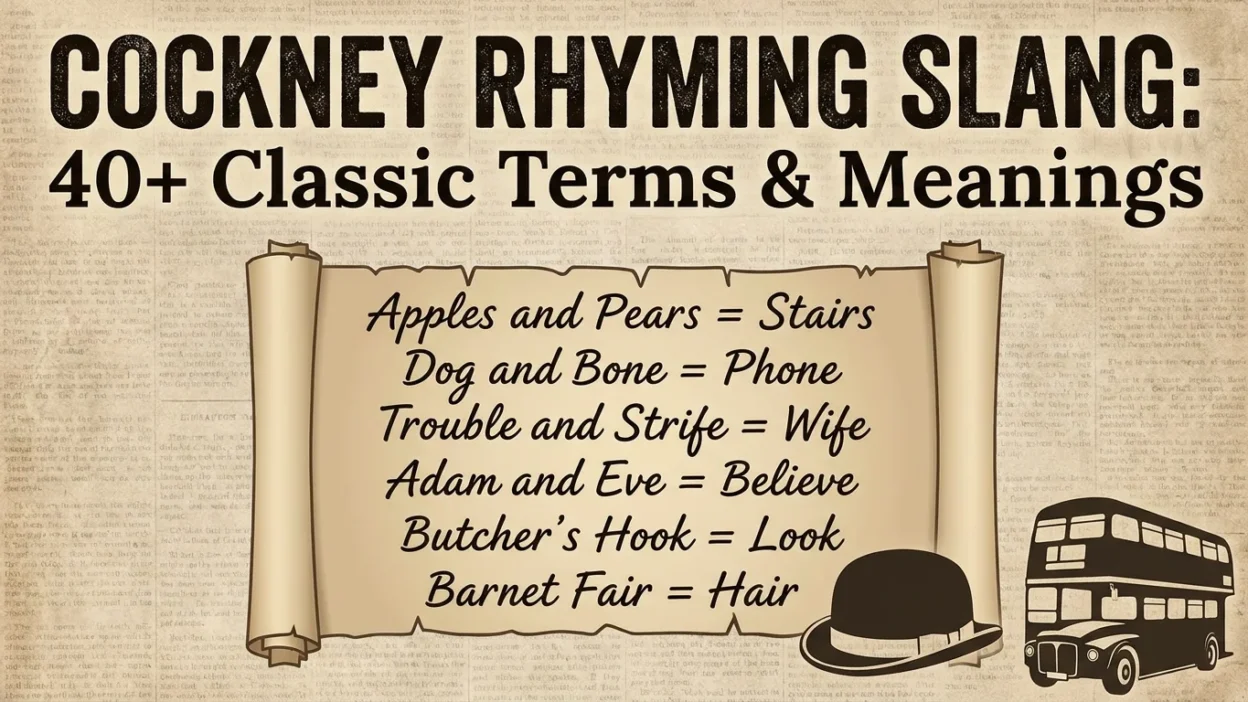
- Apples and pears = Stairs
- Dog and bone = Phone
- Trouble and strife = Wife
- Pork pies = Lies
- China plate = Mate
Using Cockney rhyming slang is like being part of a secret club. It’s confusing at first. But once you learn it, it’s so much fun.
So next time you’re in London, listen carefully. You might hear someone say, “Let’s get some Ruby down the frog.” That means curry down the road. And now? You’ll actually understand them.
That’s the beauty of Cockney rhyming slang. It’s a language that keeps you on your toes. It makes you smile. And it connects you to a rich piece of British history.
Now go on. Impress your friends. Use your loaf. And don’t tell any porkies! 😉

Kenneth Green is a writer at Namevity who shares creative ideas for game names, team names, and unique names. He focuses on helping readers find memorable and inspiring names for their profiles, teams, and projects.