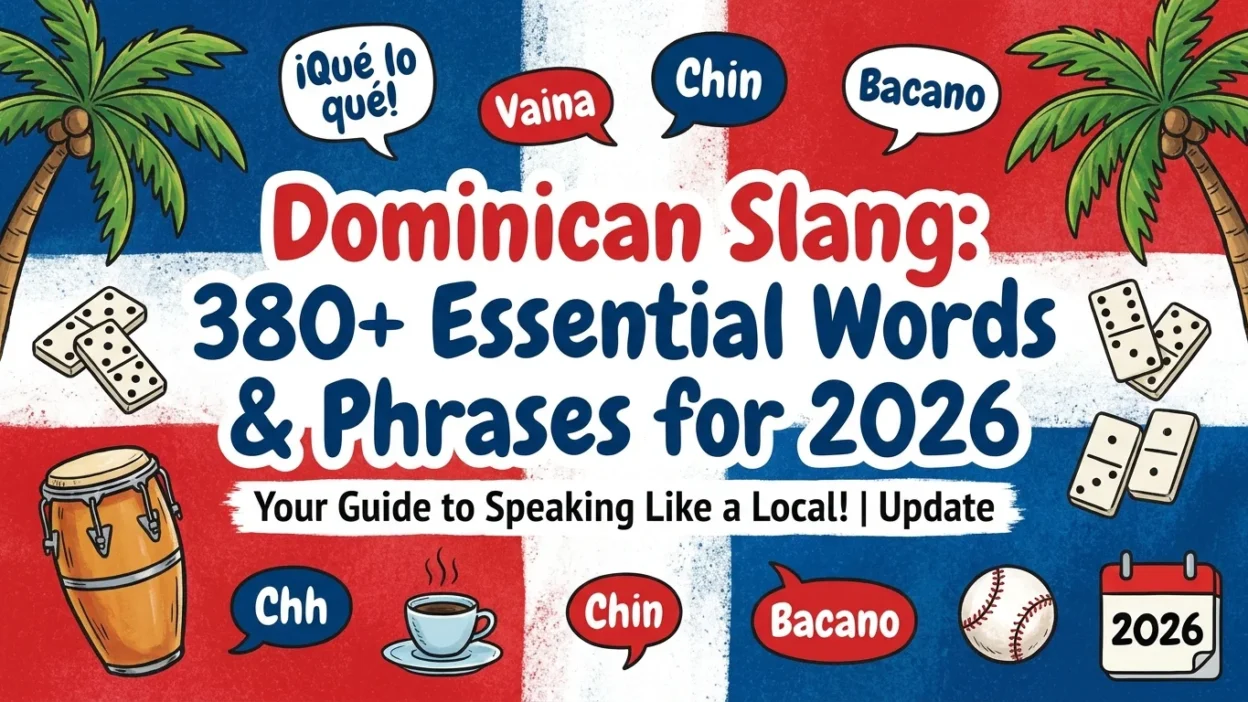
Dominican Spanish is a vibrant, fast-paced, and uniquely expressive dialect that can leave even fluent Spanish speakers completely lost. The Dominican Republic has developed its own rich slang vocabulary that reflects the country’s history, culture, and Caribbean spirit . From the Taino indigenous roots to African influences, Dominican slang is a colorful mix that gives the language its distinctive character .
Whether you’re planning to visit the DR, connect with Dominican friends, or simply want to understand the lyrics of a reggaeton song, learning Dominican slang is essential . This comprehensive guide covers over 500 Dominican slang terms, from everyday greetings to the most colorful expressions you’ll hear on the streets of Santo Domingo. Get ready to speak like a true dominicanazo !
🗣️ Essential Greetings and Street Talk
👋 The Basics of Dominican Greetings
Que lo que (keh-lo-keh or K-LO-K) This is the quintessential Dominican greeting. It means “What’s up?” and is used constantly in casual conversation . You’ll hear it everywhere from the street to the colmado. It’s the Dominican equivalent of a New Yorker saying “How you doin’?” .
Dimelo (dee-meh-lo) Another common greeting literally meaning “Tell it to me,” used to say “What’s happening?” . You can use it as a response to que lo que .
Dime ave (deem-eh-ah-beh) Short for “Dime aver” (Tell me so I can see), this is used to ask “What’s going on? What’s up?” .
Dame lu (damn-eh-loo) Derived from “Dazme Luz” (Give me light), this is another way to say “What’s up?” .
Chan (chan) This is used to address someone like “man” or “bro” . You can say “Dimelo Chan” for “What’s up man” .
Charlie or Chaili Another term for “man” or “friend,” similar to “chan” .
🤝 Phrases of Acknowledgment
Yala (ya-la) Used to say “Okay” or “Alright,” signifying agreement .
A nivel Describes when something is pleasurable or “really cool” .
Cache-cache (catch-ah) Derived from French meaning “Hide and Seek,” this is used to say “cool” or “doing good” .
Fo or Ay FO! (foh) Used to describe a bad smell, akin to saying “Eww!” in English .
Anda el Diablo or Andeldiablo Literally “The Devil Walks,” this is used to express frustration like “Damn it to hell!” .
🎉 Expressions of Surprise, Frustration, and Emotion
😱 Shock and Surprise
Carajo (car-ah-ho) A versatile curse word often translated as “hell” or “damn.” Parents might say “Vete pal’ Carajo” for “Go to Hell” .
Coño (con-yo) Another common curse word meaning “Damn!” or “Hell!” Used liberally in the DR .
Concho (con-cho) A softer way to say “coño” when you want to tone it down .
Diache (dee-ah-che) A PG-13 way to say “Damn,” derived from “Diatre” meaning devilish. Like “gosh” is to “God,” diache is to diablo .
El Pipo or Ey Pipo Used to mean “Damn!” or “Oh Damn!” when something surprising or crazy happens .
¡Bomba! Used as an exclamation of “Wow!” or surprise .
😤 Frustration and Anger
Anda el Diablo Used when you’re frustrated, similar to saying “Damn it” .
Estoy harto / Harta “I’m fed up” or “I’ve had enough.” This is used to express frustration .
Qué vaina! “What a bunch of crap!” or “What a problem!” Used when something annoying or frustrating happens .
En olla (en o-ya) To be broke or have no money .
En mala To be having economic problems or difficulty .
💬 The Legendary “Vaina” and Its Many Uses
🧰 What is “Vaina”?
Vaina (bye-nah) This is perhaps the most versatile word in Dominican slang . It can mean almost anything depending on context .
- As a thing: “¿Dónde está esa vaina?” = “Where is that thing?”
- As a problem: “¡Qué vaina!” = “What a problem!” or “Damn!”
- As stuff: “Me gusta esta vaina” = “I like this stuff”
If you’re ever stuck for a word, insert vaina—it’ll probably work .
Baina or Bainita A variation of vaina .
🐺 Street-Smart and Hustler Vocabulary
🦁 Understanding “Tiguere” Culture
Tiguere (tee-gur-eh) A tiguere is a slick-talking, finger-snapping, get-it-done kind of guy with mucho swag . It can be used to describe a player, a hustler, or a man who’s good with the ladies . Even a flirtatious toddler might be called a tiguere . It’s the Dominican equivalent of “streetwise” or “hustler” .
Tigueraje The attitude or behavior of a tiguere.
Bacano A cool dude or person .
Aficiao (ah-fee-chow) Used to describe someone who is utterly consumed by love or infatuation—”in love” to the point of being “asphyxiated” .
🕵️ Liars and Gossipers
Jablador (ha-blah-door) A liar or someone who gossips a lot. Derives from the Spanish word hablador (talker) .
Baboso (bah-bozzo) Literally “drooler,” this is used to describe someone who talks a lot of nonsense or shit—has “verbal diarrhea” .
Boca de Suape or Boca de Trapo “Big Mouth” or gossip. Literally means “Mop Mouth” .
Aguajero A BS’er, someone who brags, boasts, and talks a lot without doing anything .
Comparona Someone who likes to show off .
🚗 Transportation and Getting Around
🛵 Getting Around Town
Concho A car or motorcycle taxi used to get around the island . The term also comes from “moto-concho” .
Guagua Used in the DR for bus . In other Spanish-speaking countries, this word means “baby.”
Carro Publicos Shared public taxis that follow set routes .
Yipeta Dominican word for SUV or Jeep .
Motoconcho Motorcycle taxi—a common and affordable way to get around .
Biper / Beepear To call someone and hang up after one ring so they call you back (saving your phone minutes). From the English word “beeper” .
Toque A call (like a touch or knock) .
✈️ Travel and Directions
Avion Literally “airplane,” but used in slang to describe a woman who does sexual favors for free—an “easy” woman .
Alante Similar to adelante, meaning “move ahead” or “go forward” .
Callejones Small roads or alleys where shady things happen .
Cañada A stream that swells dangerously during heavy rains .
💰 Everyday Life and Culture
🏪 The Colmado Culture
Colmado The Dominican corner store. It’s the heart of the neighborhood where you can buy anything from a single egg to a cold beer, play dominoes, and socialize .
Colmadón A larger version of a colmado, usually with music, dancing, and food—more like a local bar .
Banca A place to place bets on baseball, the lottery, and other things .
Bola A free ride .
Dar bola To give or get a car ride .
Un chin (cheen) “A little bit.” This comes from the Taino language .
Un chinchin or chililin Even smaller than un chin—”a very little bit” .
Chele A penny or centavo .
Cielito Literally “little piece of heaven,” it describes a small tip given as a reward .
Por fa / Por fi Short for por favor (please) . Dominicans love to abbreviate words!
🍽️ Food and Drink
Bandera The traditional Dominican lunch—rice, beans, meat, and salad on the side. Literally means “flag” .
Un jumbo A 40 oz. beer served so cold a layer of frost forms on it . In this heat, there’s no point in drinking a small beer .
Cocaleka Popcorn .
Champola A drink made from guanábana (soursop) and milk .
Con-flei Corn flakes—used to refer to all cold cereals .
Bayonesa Mayonnaise—a Spanglish creation .
Bidón An aluminum container, usually used to hold and transport milk or water .
Botellón de agua The large 5-gallon blue jug of clean drinking water .
💵 Money and Work
En olla To be broke .
Fulano/a John/Jane Doe—used when you don’t want to name a specific person .
Flojo/a A lazy person .
Bago A person who doesn’t like to work .
Brega To try, struggle, or work hard at something .
La busca como un toro To work hard, literally “to look for it like a bull” .
👫 Relationships and People
❤️ Love and Attraction
Arrecho For a man to be sexually excited or erect .
Polvo Literally “powder,” but used as slang for a “nut” or ejaculation—”echar un polvo” means to “bust a nut” .
Chula Sugar mama, also a term of endearment used in the streets .
Chulea To cover someone with kisses .
Pegar los cuernos To be unfaithful—literally “to put the horns on you” .
🏳️🌈 LGBTQ+ Slang
Bugarron (boo-gah-run) A derogatory term for a man who has sex with men but takes the dominant or “giving” role . Also used as a general insult for men who don’t seem interested in women .
Maricon A derogatory term for the “receiving” partner in male-male sexual encounters .
👨👩👧👦 Family and Children
Carajito (car-ah-heet-oh) A little kid .
Chichí A baby boy .
Amorcito/a “My little love”—a term of endearment not necessarily romantic .
Joven (ho-ven) Used to address a younger person instead of “Señora,” literally “young” .
Cocotazo (cock-oh-tass-oh) A hit with a closed fist over the head—the kind of smack a kid might receive for misbehaving .
😂 Insults and Put-Downs
😤 Strong Insults
Baboso Someone who talks a lot of nonsense or BS—”verbal diarrhea” .
Boca de suape Big mouth or gossip .
Jablador A liar or gossip .
Chopo A rude term for someone of the lowest class—very offensive .
Chopa A cleaning lady or domestic servant—very rude to call someone this .
Chuverica / Chuvirica Crazy—used casually, not always without an insult .
Pariguayo (par-ee-guy-o) A poser, bullshitter, someone who is full of talk but no action .
Mongui Short for mongolo (mongoloid), used to call someone retarded .
Mojao Literally “wet,” this is a derogatory term for someone who just arrived from another country (like a “wetback”) .
Lambón A freeloader or party-crasher .
😜 Playful Insults
Chivito harto de jobo Someone who thinks they’re important but they’re actually nobody .
Chivo To be suspicious of something or someone—”to put yourself goat” means to doubt .
Buquí To make a pig of oneself .
Chichos Jelly rolls—used to refer to fat people (not endearing) .
😲 Body and Health Expressions
🦷 Body Parts and Functions
Cacú Someone with a large head .
Canillas Skinny legs .
Cocote The neck .
Chata A flat behind—no bum .
Cicote Foot odor .
Pollo A “chicken” in the lungs—used to describe phlegm .
Con-con Also the rice that sticks to the bottom of the pot, but used to describe phlegm .
Añuga To choke .
Hiede a chinchilin “You smell bad” .
🍷 Being Drunk and Sick
Ajumao Drunk .
Prenderse / Encenderse To get drunk—literally “to ignite” or “catch fire” .
Un jumo A drunk state .
Abombarse For food, fruit, or water to become rotten or spoiled .
Abombao When someone has had a lot to eat .
🏃 Actions and Verbs
🎯 Common Action Verbs
Brega To try or struggle—used for making an effort .
Soba To caress or knead .
Patina To slip—literally “to skate” .
Acoteja To organize or arrange things .
Sueltan la banda To leave something—”release the band” .
⚔️ Fighting and Violence
Ajebrarse To physically fight with another person .
Arma una piña To look for a fight—literally “to put together a pineapple” .
Te come vivo To fight or overwhelm you—”to eat you alive” .
Eplota To hit you—from the Spanish verb explotar (to explode) .
Galleta A slap on the face—literally “wafer” .
Totazo A punch or blow .
Cocotazo A smack on the head .
Bofetada / Pele’e lengua An insult or “whipping of the tongue” .
🎨 Fun and Entertainment
🎉 Parties and Celebrations
Bonche A party for a group of friends .
Bemberria A small party for friends .
Can A celebration or party .
Echar una pavita To take a nap—literally “to throw a little turkey” .
Guindar los tenis To die—literally “to hang the sneakers” .
🎮 Activities
Brechar To brag or show off .
Chequear (check-ear) To check or investigate something .
Cherchar To talk in an animated way—came from people gathering after church .
Dar muela To convince someone—”to give molar tooth” .
Bolvar el golpe To go to the bar straight from work .
🔄 The Dominican Way of Saying Things
😏 Unique Dominican Expressions
Dominicans don’t do things the conventional way—they have their own unique expressions for everything :
- Dominicans don’t give you a dirty look—they “te cortan los ojos” (cut the eyes) .
- Dominicans don’t get better when they’re ill—they “se alienta” (gets encouraged) .
- Dominicans don’t wait—they “hacen hora” (make hour) .
- Dominicans don’t go straight somewhere—they go “en bola’e humo” (in ball of smoke) .
- Dominicans don’t calm down—they “lo coje con suavena” (takes it with oatmeal) .
- Dominicans don’t repeat something slower—they “lo baraja mas alpaso” (shuffles it slowly) .
- Dominicans don’t ignore you—they “se hace el/la loco/a” (make the crazy) .
📚 Regional Variations and Influences
🏝️ Origins of Dominican Slang
Dominican slang draws from multiple sources :
- Taino: Words like chin (a little bit), chinchilín (bad smell), and cacata (tarantula) come from the indigenous Taino language .
- African: Words like chévere (cool) have African roots .
- English: Many words are Spanglish creations like biper (beeper), yipeta (jeep), and con-flei (corn flakes) .
- French: Words like cache-cache (hide and seek) .
🗺️ Regional Differences
Dominican Spanish can vary by region :
- Cibao: The northern region uses words like chepa (luck) more frequently .
- Santo Domingo: The capital has its own distinctive accent and vocabulary.
🏁 Conclusion
Dominican slang is a living, breathing reflection of the country’s vibrant culture, history, and spirit . From the streets of Santo Domingo to the beaches of Punta Cana, these words and phrases are essential for anyone who wants to truly connect with Dominican people and understand their unique way of communicating .
Remember that learning Dominican slang is about more than just memorizing words—it’s about understanding the rhythm, humor, and creativity of a culture that has its own way of expressing everything from love to frustration. As the saying goes in the DR, “A Dominican doesn’t die—they guindan los tenis (hang the sneakers)” . So go ahead, practice your qué lo qué, embrace the vaina, and enjoy the rich, colorful world of Dominican Spanish !
❓ Frequently Asked Questions (FAQs)
❓ What does “qué lo que” mean in Dominican slang? 💬
“Qué lo que” (keh-lo-keh) is the quintessential Dominican greeting that means “What’s up?” It’s used constantly in casual conversation and is the Dominican equivalent of a New Yorker saying “How you doin’?” .
🧰 What does “vaina” mean? 🧰
“Vaina” is perhaps the most versatile word in Dominican Spanish. It can mean “thing,” “stuff,” “problem,” “crap,” or almost anything depending on the context . If you’re ever stuck for a word, insert vaina—it’ll probably work !
🐺 What is a “tiguere”? 🦁
A tiguere is a slick-talking, finger-snapping, get-it-done kind of guy with swag . It can describe a ladies’ man, a hustler, or someone who’s street-smart. It can be either positive or negative depending on the context .
🚗 What is a “concho”? 🛵
A concho is a car or motorcycle taxi that’s a common form of transportation in the Dominican Republic . The full term is moto-concho for motorcycle taxis .
🇩🇴 How is Dominican Spanish different from other Spanish? 🗣️
Dominican Spanish is known for its rapid pace, dropping of certain consonants (especially ‘s’), and unique vocabulary influenced by Taino, African, and English languages . Even fluent Spanish speakers from other countries often struggle to understand Dominicans when they speak slang .
😤 What does “anda el diablo” mean? 😱
“Anda el diablo” (literally “The Devil walks”) is an expression of frustration similar to “Damn it to hell!” or “Damn!” . It’s a common exclamation when something frustrating or surprising happens.
💰 What does “en olla” mean? 💸
“En olla” means to be broke or have no money . The word olla means “pan” in Spanish, so you’re literally “in the pan” .
🏪 What is a “colmado”? 🍺
A colmado is a corner store that’s the heart of every Dominican neighborhood . You can buy anything from a single egg to a cold beer, play dominoes, and socialize. It’s an essential part of Dominican daily life .

Kenneth Green is a writer at Namevity who shares creative ideas for game names, team names, and unique names. He focuses on helping readers find memorable and inspiring names for their profiles, teams, and projects.