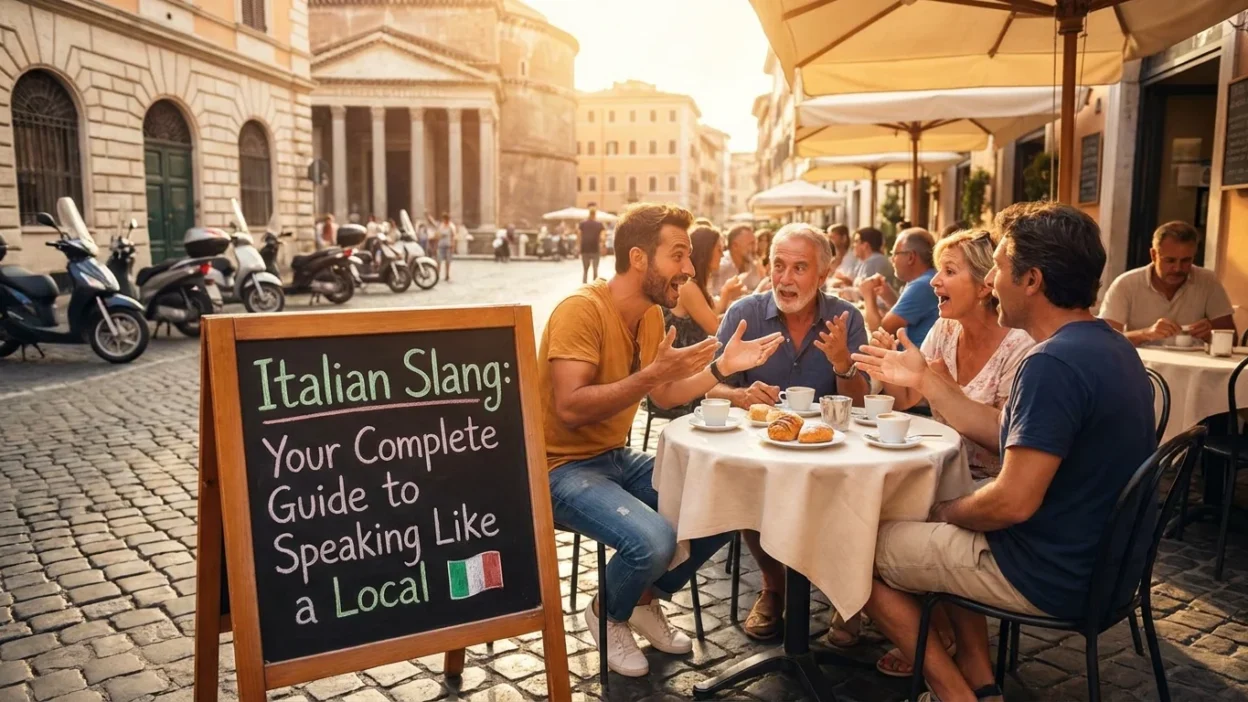
“Boh” means “I don’t know,” “figo” means “cool,” and “che figata” means “how awesome!” These are the essential Italian slang words you won’t find in textbooks but will hear constantly in everyday conversation.
Textbook Italian is formal and polite. But real Italians don’t talk like textbooks. They use slang, regional expressions, and borrowed English words. If you want to understand movies, songs, or casual chats, learning slang is a must.
Let’s dive into the most common Italian slang you’ll actually hear.
H2: The Essential Italian Slang You’ll Hear Every Day
These words are the grease that keeps everyday Italian conversation moving: colorful, expressive, and often untranslatable . Here are the absolute essentials.
H3: Boh – “I Don’t Know” (With a Shrug)
“Boh” is probably the most useful word in informal Italian . It means “I don’t know” or “who knows?” but with zero effort. Someone asks what you want to eat? “Boh.” Where should we go tonight? “Boh.”
It’s usually accompanied by a shoulder shrug and a slight frown. The gesture matters as much as the word. Southern Italians might say “chi sacciu?” instead, but “boh” works everywhere .
Example: “Boh, vediamo.” – “I dunno, we’ll see.”
H3: Figo / Figa – “Cool” or “Attractive”
“Figo” means cool, stylish, or handsome . For a feminine form, you might hear “figa,” but be careful—that version can be trickier and sometimes vulgar depending on the context . When in doubt, stick with “figo.”
Example: “Lui è figo.” – “He’s cool/handsome.”
H3: Che Figata! – “How Cool!”
“Che figata!” means something is really cool, awesome, or amazing . You’ll hear this constantly from Italians under 30. Someone posts a photo from their vacation? “Che figata!” appears in the comments .
Example: “Questo film è una figata totale.” – “This film is totally awesome.”
H3: Dai / Ma Dai? – “Come On!” or “Really?”
“Dai!” has multiple meanings depending on context :
- “Dai! Usciamo stasera!” = “Come on! Let’s go out tonight!” (encouragement)
- “Ma dai? Non ci posso credere.” = “Really? I can’t believe it!” (disbelief)
Example: “Dai, che culo!” – “Come on, what luck!”
H3: Magari – “If Only” or “Hopefully”
“Magari” is hard to translate directly. It can mean “hopefully,” “I wish,” or “maybe” . It adds flair to conversations and helps learners get the rhythm of Italian speech .
Example: “Magari domani fa bel tempo.” – “Hopefully it’s nice tomorrow.”
H3: Meno Male – “Thank Goodness”
Literally “less bad,” Italians use “meno male” when something turns out okay . For example, if the bus arrives just in time: “Meno male!”
Example: “Meno male che sei arrivato!” – “Good thing you arrived!”
H3: Cavolo – A Mild Swear Word
Literally means “cabbage,” but “cavolo” is used as a mild swear word. Think “damn” or “what the heck” . The historical reason is that cabbages were cheap, everyday food—basically worthless .
Examples:
- “Cavolo, arrivo di nuovo tardi.” – “Damn, I’m late again.”
- “Non capisco un cavolo.” – “I understand nothing.”
- “Che cavolo!” – “What the heck!”
H3: In Bocca al Lupo – “Good Luck”
The Italian way to say “good luck” sounds dramatic—it literally means “in the mouth of the wolf” . The traditional response is “Crepi!” or “Crepi il lupo!” – “May the wolf die!”Example: “In bocca al lupo per l’esame!” – “Good luck on the exam!”
H2: Everyday Slang Phrases
Slang isn’t just single words. Many of the most beloved Italian slang expressions are short phrases .
H3: Che Pizza! – “How Boring!”
Literally “What a pizza!” It means something is boring or annoying .
Example: “Che pizza, questa lezione!” – “How boring, this lesson!”
H3: Essere al Verde – “To Be Broke”
Literally “to be at the green.” It means having no money .Example: “Dopo le vacanze, sono al verde.” – “After vacation, I’m broke.”
H3: A Fagiolo – “Just Right”
Literally “at the bean.” It means perfectly timed or exactly right .
Example: “Il tuo messaggio è arrivato a fagiolo.” – “Your message came at just the right moment.”
H3: Non Me Ne Frega Niente – “I Don’t Care at All”
This is very informal and means “I don’t care at all.” Use cautiously .
Example: “Non me ne frega niente.” – “I don’t care at all.”
H3: Sono Cotto – “I’m Exhausted”
Literally “I’m cooked.” You can use this when you’re really tired, like after a trip or a day sightseeing .
Example: “Sì, ma sono cotto.” – “Yes, but I’m exhausted.”
H3: Un Sacco di – “A Ton of”
Literally “a sack of.” It means a lot of something .
Example: “Ho mangiato un sacco di roba.” – “I ate a ton of stuff.”
H3: Un Botto – “A Lot”
“Un botto” literally means “a bang” or “a blow,” but in slang, it’s a casual way of saying “a lot” or “tons” .
Examples:
- “Ho speso un botto.” – “I spent a ton of money.”
- “Ho un botto di cose da fare.” – “I’ve got a ton of things to do.”
- “Mi piace un botto.” – “I like it a lot.”
H3: Ci Sta – “Sounds Good” or “It’s Alright”
“Ci sta” is a casual way to say “ok” in Italian: not an overly enthusiastic “Yes, let’s do it!” but more like a relaxed “yeah, sounds good” .
It can also mean something is fine but not amazing .
Examples:
- A: “Regaliamo un buono a tua sorella?” – “Should we give your sister a gift card?”
- B: “Ci sta.” – “Sounds good.”
- A: “Ragazze, vi piace questa gonna?” – “Guys, do you like it?”
- B: “Ci sta.” – “It’s alright.”
H2: Regional Slang: Rome vs. Milan vs. Sicily
Italian slang changes dramatically by region. What works in Rome sounds wrong in Milan . Here’s a taste :
- Aò – Roman greeting or attention-getter
- Daje – “Come on!” / “Let’s go!”
- Guagliò – “Kid” or “guy” (from Neapolitan dialect)
- Jammo – “Let’s go” (from “andiamo”)
- Bedda – “Beautiful” (feminine)
- Minchia – Expressive exclamation. Tone and context matter a lot
- Miiiiiii! – Expression of surprise
- Sballo – “Great fun”
- Pirlare – “To waste time” (informal, from Lombard dialect)
Using Roman slang in Sicily won’t confuse anyone, but you’ll sound like you learned Italian from Roman TV shows .
H2: Italian Text Slang and Abbreviations
If you’ve ever scrolled through Italian TikTok or tried chatting with young Italians online, you probably noticed they’re not exactly speaking textbook Italian . Here are the abbreviations Italians use constantly in chat messages and comments :
SlangMeaningTvb“Ti voglio bene” – I love you (platonic, for friends/family)Cmq“Comunque” – Anyway / HoweverNn“Non” – NotXke / Xk“Perché” – Why / Because (the “x” replaces “per” since it sounds similar)Xo“Però” – But / HoweverRisp“Rispondi” – Answer / ReplyMsg“Messaggio” – MessageDp“Dopo” – After / Later
H2: Gen Z Italian Slang (When English Invades)
Italian youth slang is heavily influenced by English, especially online . Here are the most common Gen Z terms :
SlangMeaningPostareTo post (on social media)ShippareTo “ship” (support a romantic relationship)Flexare / FlessareTo show off / flexSpoilerareTo spoil (a movie, book, etc.)TriggerareTo trigger someoneCrushareTo have a crush on someoneChillareTo chill / relaxGhostareTo ghost someoneCringeCringe (stays in English)
These are just English verbs with Italian conjugation slapped on. It sounds ridiculous to older Italians, but it’s everywhere among young people .
H2: Context Is Everything: Formal vs. Slang Italian
Slang is for friends and peers. Formal Italian is for work, strangers, or writing emails .
💡 Golden Rule: If you’re not sure whether slang is appropriate, start formal—you can always loosen up later .
Slang is okay for:
- Friends and family
- Casual text messages
- Street conversations and bars
- Social media
Avoid slang for:
- Work meetings
- Speaking with strangers in professional settings
- Writing formal emails or official documents
H2: FAQs (4 Questions, Answered in 2-3 Lines)
H3: What does “boh” mean in Italian slang?
“Boh” means “I don’t know” or “who knows?” It’s the most common Italian slang word. Italians often use it with a shoulder shrug.
H3: What does “che figata” mean in Italian?
“Che figata” means “how cool!” or “how awesome!” It’s used to express excitement or approval. Italians under 30 use it constantly.
H3: What does “cavolo” mean in Italian slang?
“Cavolo” literally means “cabbage,” but it’s used as a mild swear word. Think “damn” or “what the heck.” It’s not offensive.
H3: Is Italian slang different by region?
Yes, very much so. Rome has “daje” (come on), Naples has “guagliò” (guy), and Sicily has “bedda” (beautiful). What works in Rome sounds wrong in Milan.
H2: Final Thoughts
Italian slang is the key to unlocking real, natural Italian conversations. Textbook Italian is formal. Slang is how people actually talk.
Start with the basics: boh, figo, che figata, and dai. Listen to how locals use them. Practice with friends. And don’t be afraid to make mistakes—Italians appreciate the effort.
Just remember: slang is casual. Avoid it in formal situations, with strangers, or with people you need to impress. But with friends? Go wild.
Dai, che figata! – Come on, how cool is that! 🇮🇹

Kenneth Green is a writer at Namevity who shares creative ideas for game names, team names, and unique names. He focuses on helping readers find memorable and inspiring names for their profiles, teams, and projects.